
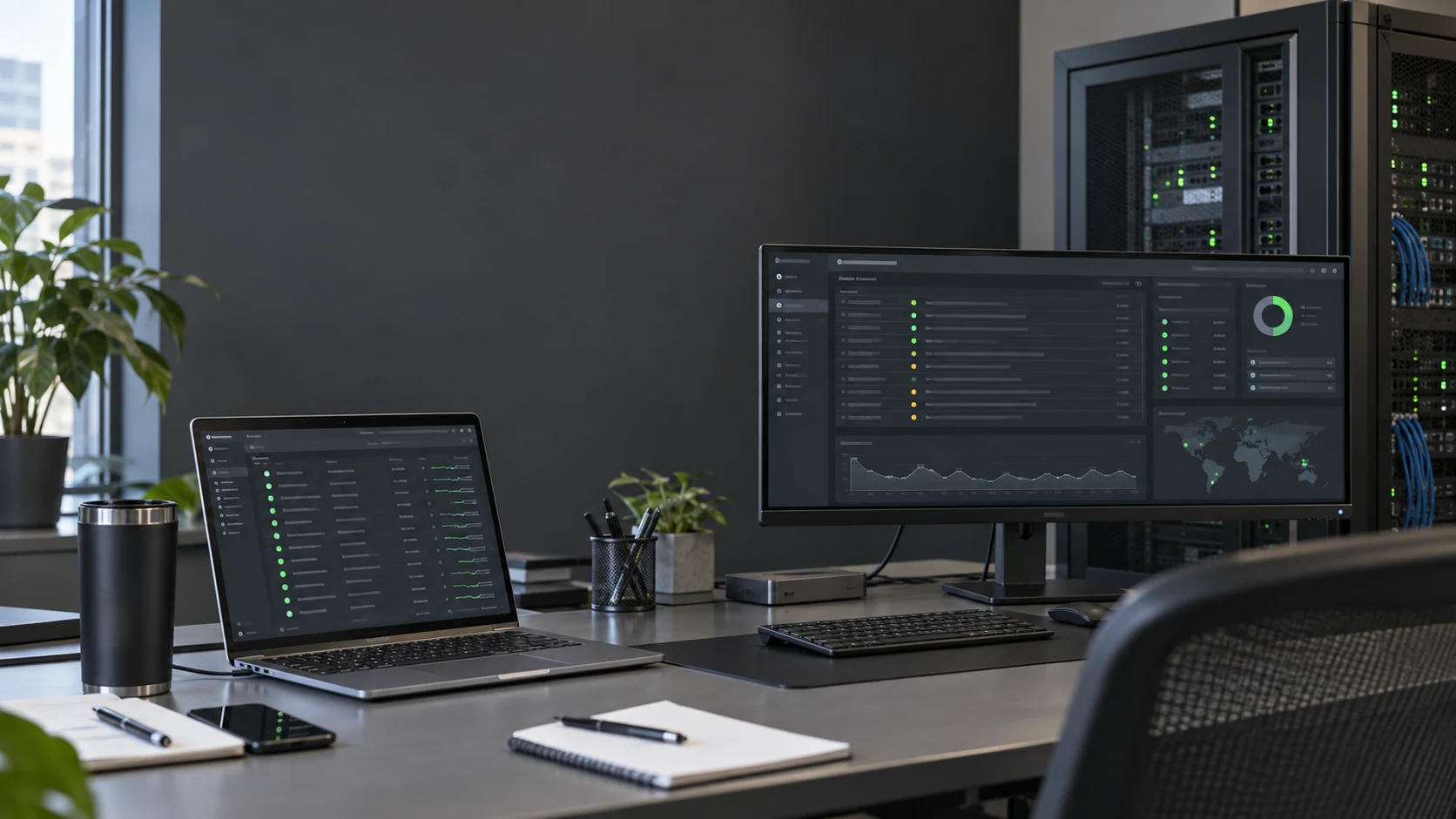
Illustrative endpoint-security workstation with laptop, event display and network cabinet

EDR + MDR / British Virgin Islands

Endpoint Detection & Response.
Managed Detection & Response.

Connect endpoint protection with a clear response process. MicroAntix helps your organization investigate suspicious activity, contain risk and improve security operations.

Technology and expertise

Choose the right level of security operations.

Installing an endpoint agent is only the beginning. Someone must maintain coverage, investigate alerts, understand the business context and decide what action is appropriate. We define those responsibilities before deployment so security events do not sit between your internal team and an external provider.

EDR / The endpoint layer

Visibility and response tools.

Endpoint Detection and Response collects supported device activity and identifies behavior that needs investigation. It gives authorized teams the evidence and controls to examine an alert, isolate a device or remediate a threat according to policy.

  • Supported laptops, desktops and servers enrolled into management
  • Detection policies, exclusions and device-health monitoring
  • Endpoint timelines and investigation context
  • Supported containment and remediation actions

Appropriate when your organization has a defined owner for alert review and response, whether internal or contracted.

MDR / The managed service

Investigation with accountable follow-through.

Managed Detection and Response adds analyst-led review, investigation and response coordination over the agreed environment. The service should identify who investigates, who contacts your organization and which actions can be taken without waiting for further approval.

  • Alert triage and contextual investigation
  • Threat hunting where included in the chosen service
  • Escalation to named business and technical contacts
  • Documented response actions and service reporting

Coverage hours, service provider, supported data sources and response commitments are confirmed in the agreement.

From signal to action

A response path that everyone understands.

  1. 01

    Detect

    Collect supported telemetry and check that agents are healthy. Detection rules and platform analytics identify activity that warrants review; an alert is a signal to investigate, not automatically proof of compromise.

  2. 02

    Investigate

    Review the affected device, user, process and surrounding events. Analysts distinguish expected activity from suspicious behavior and assess potential business impact before choosing the next action.

  3. 03

    Contain

    Apply agreed measures such as endpoint isolation or malicious-file quarantine where supported. Business-critical systems follow the approved escalation and authorization process to balance urgency with operational impact.

  4. 04

    Recover & improve

    Coordinate remediation and recovery with responsible IT teams, document decisions and review how the incident occurred. Findings inform configuration changes, patching, access improvements and future response procedures.

Managed coverage

Keep the protected estate visible.

We establish a device inventory, identify supported operating systems and review how remote devices connect. Deployment is phased where appropriate, with pilot testing for line-of-business applications and documented exceptions. Unsupported or intermittently connected devices are identified rather than silently assumed to be protected.

  • Agent deployment and enrolment verification
  • Device health, stale devices and coverage gaps
  • Policy maintenance and carefully justified exclusions
  • Security platform access and administrator permissions

Operational context

Turn alerts into a business conversation.

A suspicious action on a front-desk workstation may require a different response from the same alert on a finance server. We record critical assets, service dependencies, business contacts and escalation routes so response decisions reflect the organization, not just a severity label.

  • Critical-service and asset-owner mapping
  • Named primary and alternative escalation contacts
  • Response authority and incident communication procedures
  • Review of recurring alerts and unresolved remediation actions

Deployment & governance

Build the service before relying on it.

MicroAntix reviews existing protection and licensing, agrees the monitored scope and coordinates deployment with your team. Product selection may include an appropriate enterprise endpoint platform such as Microsoft Defender for Endpoint, subject to supported systems and licensing. We do not assume all products provide identical capabilities.

Scope

Inventory endpoints and relevant cloud or identity integrations. Record exclusions, unsupported systems and responsibilities for assets outside the service.

Configure

Pilot policies, tune noisy detections and verify platform access. Test the agreed escalation process before moving into routine operation.

Review

Report on coverage, important detections, response activity and outstanding actions. Review frequency and the level of reporting are agreed with the customer.

Improve

Use recurring findings to prioritize patching, authentication, backup readiness and staff awareness. Security improvements should have owners and realistic completion dates.

Practical expectations

Security operates as a set of controls.

EDR and MDR complement email and Microsoft 365 security, staff awareness, vulnerability management and backup. They are not a guarantee against ransomware, data loss or every new threat. A clear service description matters as much as a strong product.

Incident readiness

Know what happens beyond containment.

Before an incident, agree who approves major changes, who coordinates restoration and when specialist incident response is required. Forensic investigation, legal advice, notification decisions and full disaster recovery may require separate specialists or engagements. Those boundaries should be understood before a high-pressure event.

Common questions

Before we begin.

Clear scope, practical expectations and a service designed around your organization.

How are EDR and MDR different?

EDR is the endpoint technology used to collect security signals, detect suspicious activity and support investigation and response. MDR is a managed service that adds analyst-led monitoring, investigation and response coordination over the agreed technology and scope.

Does the service include 24/7 monitoring?

Continuous automated detection and 24/7 analyst coverage are different things. Where a 24/7 MDR service is selected, the provider, monitored sources, escalation process, response authority and exclusions are documented in the agreement. Not every support plan includes round-the-clock human response.

Can a device be isolated automatically?

Supported platforms can isolate an endpoint or take other containment actions. Automatic and analyst-led actions must be agreed in advance, with particular care for critical servers and operational systems where isolation could interrupt service.

Can you work with our existing security tools?

We assess the current platform, licensing, supported operating systems and management access before recommending retention, integration or replacement. An existing product does not automatically make every device or cloud service part of the monitoring scope.

Does EDR replace backup and disaster recovery?

No. Detection and response reduce risk and support containment, but recovery still needs appropriate backups, restoration procedures, patching, access controls and a tested continuity plan. No security product guarantees that an incident cannot occur.

British Virgin Islands

Local delivery. Connected support.

Professional offices, hospitality operators and distributed BVI teams depend on laptops, desktops, servers and cloud accounts that may be used outside a single office. We build the service inventory around those working patterns, identifying supported systems and the responsibilities of local staff, internal IT and managed security providers.

MicroAntix coordinates discovery, implementation and ongoing assistance around your operating hours, site access and agreed support arrangements. For multi-island work, travel, equipment availability, connectivity and maintenance windows are addressed in the project plan.

Tortola & Road TownVirgin GordaAnegadaJost Van DykeOther BVI islands

Plan your next step

Define your endpoint protection and response plan.

Tell us about your devices, current tools and internal IT capacity. We will help clarify coverage, responsibilities and the right service model.